Loading...
Serving Atascadero, CA and surrounding areas. (805) 391-5930
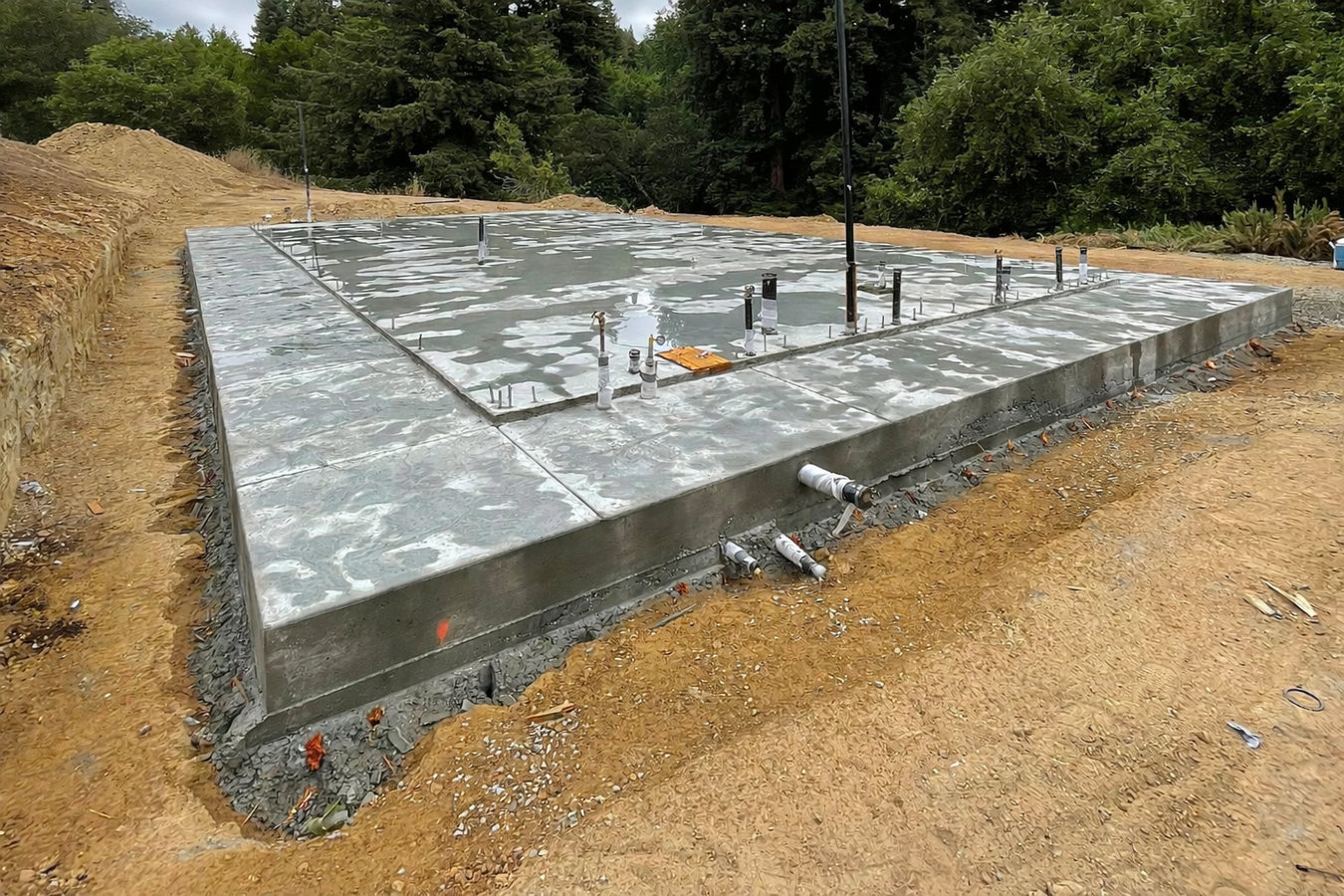
A slab poured on unprepared ground is an expensive mistake waiting to happen. We build slab foundations in Atascadero designed for the clay soils and seismic conditions of the Central Coast - so your project starts on ground that will hold.
Slab foundation building in Atascadero involves compacting the soil, adding a gravel drainage layer and plastic moisture barrier, placing seismic-code steel reinforcement inside wooden forms, and pouring the concrete in a single continuous pour - most residential slabs take one to two weeks from ground prep to an inspected, cured foundation ready for framing.
If you are building a new home, adding an accessory dwelling unit, or converting an outbuilding on your Atascadero property, the slab foundation is the first structural step and everything else depends on it. The clay-heavy soils found throughout much of Atascadero mean soil preparation is not a step to rush - how the ground is prepared before the pour directly determines how the slab performs over the next 30, 40, or 50 years.
For projects that include underground support work, our concrete footings service handles the deeper perimeter footings that anchor the slab when site conditions call for added support.
The clearest sign is a construction project that has no foundation yet. If you have purchased a lot in Atascadero or are planning a home addition, garage, or accessory dwelling unit, a slab is typically the first step. No other construction work can begin until the slab is in place and has passed the city inspection.
Hairline cracks in concrete are normal, but cracks you can fit a quarter into - or sections of floor that have shifted up or down relative to each other - signal that the foundation has moved. In Atascadero, this kind of movement is often linked to clay soils expanding and contracting through wet winters and dry summers. A professional assessment can tell you whether repair or replacement is the right path.
When a slab settles unevenly, the house frame above it shifts - and the first place most homeowners notice is in doors and windows that no longer latch or swing freely. This is especially common in older Atascadero homes built before current soil preparation standards were in place. It does not always mean a full slab replacement, but it does mean the foundation needs a professional look soon.
Atascadero gets most of its rainfall between November and March. If water consistently pools against your foundation after a storm, it is a warning sign. Persistent moisture against or under a slab accelerates the expansion-contraction cycle in clay soils and can eventually undermine the slab's stability. Addressing drainage - and potentially reinforcing the foundation section - is worth doing before the next rainy season.
Every slab project begins with a site assessment - we look at your lot conditions, note any slopes, large trees, or drainage issues, and confirm what the soil requires before we design the foundation. Once permits are approved by the City of Atascadero Building Division, we grade and compact the soil, lay a gravel drainage layer, and install the plastic moisture barrier. Steel reinforcing bar is then placed inside the wooden forms in a pattern that meets California's seismic code requirements for this region.
Pour day is a single, continuous operation - concrete trucks arrive, the crew fills the forms, and the surface is leveled and finished before the concrete begins to set. After the pour, we follow a proper wet-curing schedule for the warm, dry Atascadero climate - keeping the slab moist for several days so it gains full strength from the inside out. For projects that include a full structure above the slab, our foundation installation service covers the complete scope. The American Concrete Institute publishes the standards that guide how concrete slabs are designed and placed - learn more at concrete.org.
Suited for any Atascadero lot - we identify clay content, drainage patterns, and root proximity before finalizing the foundation design.
We handle the full permit process with the City of Atascadero and schedule required inspections so your timeline stays on track.
Ideal for properties with clay-heavy soil - the drainage layer and vapor barrier prevent moisture from wicking up through the slab over time.
Required by California building code for foundations in this region - the steel reinforcement pattern is verified by the city inspector before any concrete is poured.
For homeowners who want a uniform slab without cold joints - the entire pour happens in one session so there are no weak seams in the finished foundation.
For Atascadero properties on hillside parcels or building accessory dwelling units - we design the grading and formwork to suit your specific terrain.
Atascadero sits in a seismically active region of San Luis Obispo County, and the soils throughout much of the city have a significant clay content. That combination means a slab built here carries two specific challenges that a contractor from outside the area might not account for: seasonal soil movement from clay expanding and contracting, and code-required seismic reinforcement that goes beyond what lower-risk states demand. The 2003 San Simeon earthquake was a reminder that ground movement is a real factor in this part of California, not a theoretical one. California's seismic requirements for slab foundations - including specific rebar patterns verified by city inspection - exist because of exactly that reality. For current seismic hazard information in San Luis Obispo County, the California Geological Survey publishes detailed hazard zone maps at conservation.ca.gov/cgs.
Many Atascadero properties - particularly on the hillsides east of Highway 101 and in the neighborhoods surrounding Atascadero Lake - sit on sloped or oak-covered lots where root proximity and drainage add another layer of planning before any concrete is poured. Homeowners in Paso Robles and San Luis Obispo face similar terrain and soil challenges, and we work across all of these communities with the same attention to what the specific lot requires.
We reply within one business day to schedule a site visit. We walk the property in person, assess soil and slope, and take measurements so the estimate reflects your actual situation - not a generic square-footage number.
We submit the permit application to the City of Atascadero Building Division on your behalf. Permit approval typically takes one to three weeks. We use that time to finalize the foundation design based on your lot's soil conditions.
Once the permit is approved, the crew excavates, compacts, lays the gravel and moisture barrier, and sets the rebar inside the wooden forms. The city inspector visits at this stage to verify the reinforcement before any concrete is poured.
Pour day is a single continuous operation, typically four to eight hours. The slab then cures for at least seven days - we keep it moist in Atascadero's dry climate - before the city does the final inspection and framing can begin.
Free on-site estimate. We handle permits and inspections from start to finish.
(805) 391-5930We work on lots throughout San Luis Obispo County and understand how the clay-heavy soils in and around Atascadero behave through the wet and dry seasons. That local knowledge shapes how we design every foundation - from footing depth to gravel base thickness.
California's code requires specific rebar placement for foundations in seismically active areas like San Luis Obispo County. We build that reinforcement into every slab we pour - it is not an add-on, it is standard. The city inspector verifies it before the pour, so you have an independent confirmation the work meets code.
We submit the permit application to the City of Atascadero Building Division, coordinate with the city inspector at each required stage, and give you the signed inspection record at the end. You do not have to track down paperwork or follow up with the city - we handle that.
Atascadero summers can cause a freshly poured slab to dry too fast at the surface before the interior has fully cured. We follow a wet-curing process for the first several days after every pour, keeping the slab moist so it reaches its full design strength rather than being rushed. A foundation that cures properly performs better for decades.
Every slab we pour is backed by a paper trail from permit application to final inspection sign-off. That record protects your investment - it matters when you refinance, sell, or add on to your home.
Full foundation installation for new homes and additions, including excavation, forming, and seismic-code rebar placement.
Learn MorePerimeter and interior footings that anchor the slab when deeper support is needed for your lot's soil conditions.
Learn MoreAtascadero's dry season fills up fast - call today to lock in your project date before the schedule closes.